
Growth, distribution, and monetization require ongoing strategy, and most creators or brand teams simply don't have the bandwidth to build that in-house. That gap is exactly why podcast marketing agencies exist. They offer everything from SEO-optimized show notes to social clipping to sourcing actual brand deals.
This guide breaks down what these agencies actually do, the five core strategies they lean on, what it realistically costs, and how to pick a partner that won't leave you stuck at "published" instead of "profitable."
Key Takeaways
- Agencies bundle distribution, SEO, social repurposing, and monetization so you skip building an in-house team
- Of the 5 core strategies, running 2-3 consistently beats spreading thin across all of them
- Budgets span a few hundred dollars in self-serve tools to multi-thousand-dollar monthly retainers
- Monetization scales with audience quality and niche fit, not just download counts
- Top agencies tie production straight to revenue—not only editing and publishing
What Does a Podcast Marketing Agency Actually Do?
Most agencies bundle a similar core set of services:
- Post-production and editing
- SEO-optimized show notes and transcripts
- Short-form clip creation for social platforms
- Distribution strategy across podcast apps and websites Social repurposing is a big piece of this. Agencies turn a single episode into audiograms, short-form video clips, and quote graphics, extending its reach without eating into the creator's schedule. One 40-minute episode can become 10-15 pieces of standalone content.

Guest Networks and Paid Placement
Agencies also build media kits and pitch cross-promotion partnerships on a client's behalf, making it easy for guests to share episodes with their own audiences. On the paid side, they select shows or platforms, negotiate CPM-based placements, and manage the campaign end-to-end.
Beyond Distribution
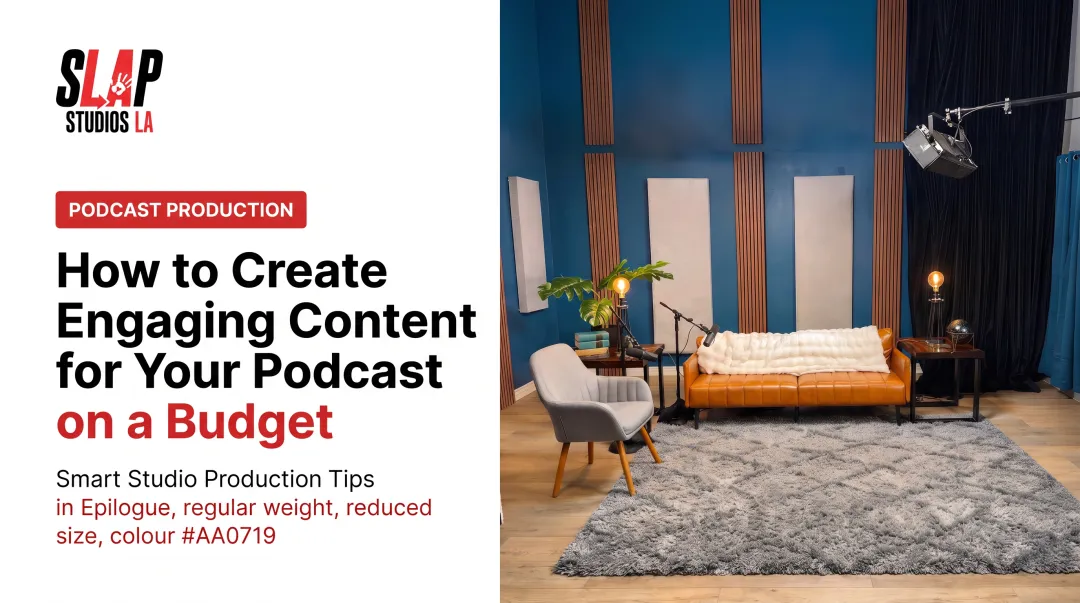
Some agencies go further than distribution alone. SLAP Studios LA, based in West Hollywood, combines studio production, content strategy, and an in-house brand deals division under one roof. Instead of stopping at a published episode, they connect the recording session directly to sponsorship and e-commerce revenue. That full-funnel model matters because production and marketing budgets rarely balance. In a global survey of 861 marketing and PR professionals, 41.8% of organizations allocated more budget to production than to marketing, while 26.1% spent more on distribution and promotion than on production (Outcomes Rocket, 2026). That imbalance is a big reason so many good podcasts stay unheard.
The 5 Main Podcast Marketing Strategies
Agencies typically draw from five channels. Most successful shows lean hard into 2-3 of these rather than trying to do everything.
- Social media distribution — Zero-click content (pulling episode insights directly into a post, no link required) plus audiograms and short-form video clips
- Podcast SEO — Keyword research for titles and descriptions, optimized show notes, full transcriptions, and a dedicated podcast landing page
- Guest and network distribution — Media kits that make it simple for guests to promote the episode to their own audience
- Cross-promotion and paid advertising — Swapping shoutouts with comparable shows, plus targeted paid spots
- Community and internal distribution — Niche online communities, employee advocacy, and industry newsletters, which most creators overlook entirely

Of those five, paid placements reward extra attention to format—host-read versus pre-recorded can change results as much as the channel choice itself.
Host-Read vs. Pre-Recorded Ads
If you're testing paid placements, format matters. Host-read ads drove 1.3x more purchases per impression than pre-recorded (producer-read) ads, according to Podscribe's Q3 2024 benchmark covering more than 200 advertisers and 63,000 campaigns (Podcast News Daily).
A separate Dentsu/Lumen study found host-read ads produced 10 points higher unaided recall than pre-recorded announcer spots.
Paid promotion is also worth testing because podcast listeners pay attention. Among the most active listeners, ad recall hit 86%—the highest of any media platform in Sounds Profitable's 2025 Advertising Landscape survey of over 5,000 US adults.
That same group trusted podcast ads more than traditional or social media.
Building a Content Strategy: The 7 Steps
Agencies typically map out a strategic roadmap with clients before a single mic gets turned on. The framework usually breaks into seven steps:
- Define goals — Brand awareness, lead generation, or revenue? Pick one primary goal.
- Understand your audience — Who are they, and what platforms do they already use?
- Develop positioning — What makes this show different from the 100 others in the niche?
- Choose a format — Interview, solo, co-hosted, narrative?
- Plan an editorial calendar — Map episodes to themes, guests, and release dates.
- Assign production roles — Who edits, who publishes, who pitches guests?
- Distribute and track performance — Measure what's actually working, not just what feels good.

Skipping step one is the most common reason podcast marketing plans fail to show ROI. A 2026 global survey of 861 marketing and PR professionals found that while 58.1% cited brand awareness as their primary goal, only 16.8% formally tracked ROI — even though 47.3% rated their podcast's ROI as strong (Outcomes Rocket).
Without a defined goal upfront, that measurement gap only widens. Agencies build this roadmap with clients before recording begins for that reason—not after episodes are already live.
Podcast Marketing Costs & Earnings Potential
How Much Does It Cost to Market a Podcast?
Costs scale dramatically with scope:
- DIY/self-serve tools: A few hundred dollars monthly for scheduling, basic clipping, and hosting
- Agency retainers: Range from social/SEO-only support to full production, distribution, and monetization; price tracks scope and deliverables
- CPM-based paid advertising: Host-read sponsorships typically run $25-$40 CPM, while pre-recorded spots under 30 seconds run $15-$30 CPM, per Acast's 2026 advertising guide
Studio-based production adds another layer. For reference, SLAP Studios LA hourly tiers break down like this:
| Tier | Rate | Includes |
|---|---|---|
| Bronze | $79/hour | Room only |
| Silver | $139/hour | Full audio/video |
| Gold | $179/hour | Multi-camera editing |

A custom Platinum package covers strategy, clips, and monetization support on top of production.
How Much Do Podcasts With 10,000 Listeners Make?
No universal number exists here—and any agency claiming one is guessing. Earnings track niche and engagement more than raw downloads. Typical revenue streams include:
- Sponsorships and host-read ad reads
- Affiliate links tied to relevant products
- TikTok Shop commerce revenue
- Programmatic / network ad insertion (CPM-based)
Brands often start considering sponsorship at 1,000-5,000 downloads per episode, according to Spotify for Creators. At 10,000 listeners, a show is already in sponsorship-viable territory if the audience is engaged and niche-specific.
Creators who pair production with brand-deal access tend to monetize faster than those chasing downloads alone. SLAP Studios LA shows why: the studio owns consumer brands across wellness, skincare, apparel, and children's health, so agency clients can tap sponsorship, affiliate, and revenue-share deals from day one instead of cold-pitching for months.
One documented example: SLAP connected The Charley King Show with 24k Wellness as an official sponsor.
How to Choose the Right Podcast Marketing Agency
Not all agencies offer the same depth. Before signing anything, run through this checklist:
- Check pipeline coverage. Does the agency handle production, SEO/social, and monetization — or just recording?
- Ask about brand relationships. In-house brand portfolios or affiliate networks shorten the path from content to income far more than generic sponsor outreach alone.
- Confirm pricing transparency. Watch for hidden add-ons on equipment, editing, or distribution that aren't disclosed upfront.
- Verify real experience. Has the team actually produced and monetized their own content, or are they just selling theoretical strategy?
SLAP Studios LA shows what the integrated model looks like in practice. Based in West Hollywood, it runs three connected divisions—studio, agency, and brand deals—under one roof.
Its founders spent years producing their own podcasts and losing money learning the hard way before they built this operation. Clients get access to owned brands like 24k Wellness, 24k Skincare, 4G Apparel, Opti-Fit, AS4, and 5 Children's Health for sponsorship and affiliate deals.
For creators who don't want to hire five different vendors, that consolidation is the whole point.
Frequently Asked Questions
How much does it cost to market a podcast?
Costs range from a few hundred dollars monthly for self-serve tools to multi-thousand-dollar agency retainers. Paid advertising typically runs $15-$40 CPM depending on format, and full-service production packages add further cost on top.
What are the 5 main marketing strategies?
The five core strategies are social media distribution, podcast SEO, guest and network distribution, cross-promotion, and paid advertising. Most shows see the best results focusing on 2-3 of these consistently.
What are the 7 steps in creating a content strategy?
Define goals, know your audience, set positioning, choose a format, build an editorial calendar, assign production roles, then distribute and track results. Skipping the goal-setting step is the most common cause of poor ROI.
How much do podcasts with 10,000 listeners make?
Income varies more by niche and engagement than by download count. At around 10,000 listeners, many shows earn from a few hundred to several thousand dollars a month through sponsorships, affiliates, TikTok Shop, and CPM ads.
Do I need a large audience for podcast marketing to work?
No. A smaller, highly engaged, niche-specific audience often monetizes better than a large but passive one. Brands frequently consider sponsorship starting around 1,000-5,000 downloads per episode.
Should a brand build an in-house podcast marketing team or hire an agency?
It depends on budget and timeline. Hiring in-house means recruiting multiple specialists; agencies provide an entire team (editing, SEO, social, and often monetization) without the hiring overhead.
Can you help grow or promote my podcast?
Yes. Beyond recording, SLAP Studios LA operates a content agency and brand deals division, so support can extend to short-form clips, publishing assistance, growth consulting, marketing, and brand-partnership opportunities. These are scoped as part of a custom Platinum package rather than included in hourly Bronze, Silver, or Gold sessions.
Do you help first-time podcasters?
Yes. First-time creators are a core part of who the studio works with, and a full-service Silver or Gold session means you do not need to own equipment or know how to run a multi-camera setup. The on-site engineer handles cameras, microphones, and lighting during the session, and the team can talk you through format, episode structure, and what you will receive afterward before you book.